
Vitamin–D for your life
In ancient Greece, centuries before the birth of Christ, Icarus — a technologically enhanced human — flew too close to the sun and perished. His situation was a precarious one. Fly too low and the dampness of the sea might clog his DIY wings of feathers and wax; fly too high and the sun would, as it ultimately did, melt the wax and cause the impromptu construction to fall apart.
The story of Icarus is, as most Greek tragedies are, one of hubris and nemesis. Despite clear instructions to take the middle way, Icarus recklessly (and literally) aimed too high. The story is a warning against the headless pursuit of instant gratification, in accordance to Greek ideals of self–control and moderation.
Traditionally, hubris is a matter between men and gods. Now, it may more appropriate to look at hubris as a matter between men and machines. Perhaps Icarus’ crime was not that he flew to close to the sun, but rather his attempt to tamper with the limitations of his human body. By donning the set of wings made by his father Daidalos, Icarus turns himself into what is perhaps the first mythological cyborg: A being made of both organic and biomechatronic material. The cyborg aggresively entered the public mind in the early 60’s. Since its birth, the cyborg has consistenly been met with simultaneous dread and delight. It is evolution on amphetamine, Homo Sapiens 2.0: an embodiment of technological development superseding the course of nature.
Approximately 60 years before the emergence of the cyborg, the Wright brothers flew the first airplane. Though far from the chimeric creature envisioned in the story of Icarus and later, with more realistic intents, by Leonardo Da Vinci, the Wright brothers made part of the myth come true. Interestingly, though perhaps not surprisingly considering what we know about human nature, our ascent towards the sun did not come to an end when we brought ourselves closer to it. We had to bring the sun closer to us, too; make it readily available independent of nuisances such as seasons, weather and time of day. Man’s relationship to the sun has always been slightly dysfunctional, in a state of can’t live with it/can’t live without it. Our entire eco–system entirely depends on it, yet too much exposure causes draught and desolation. Indigenous people of America danced to make the sun appear, and then again to make it go away. In most parts of the world, skin untouched by sunrays is — or was until recently — a signifier of wealth and leisure. In the early 20th century, sunbathing was prescribed for curing tuberculosis and lupus. Too little sun exposure causes vitamin D–deficiency and depression; too much exposure will give you arc eye, wrinkles and cancer.
This summary of our aesthetic and medical issues with the sun is unjustly brief, but it serves the purpose of illustrating why we might want to gain the upper hand over the sun. Enter the tanning beds:
megaSun 7900 α—Deluxe
T R ◯ N
SunQuest Wolff 24RSP
Solar System V.I.P. 42
CyberTech Sundash SD—2 G∃n∃sis
PureTan Ξclipse III
SunMaster Shadow 32
S⊙lar St⊙rm 16RS
Allure 360°
ϚunCapsule SuperCyclone
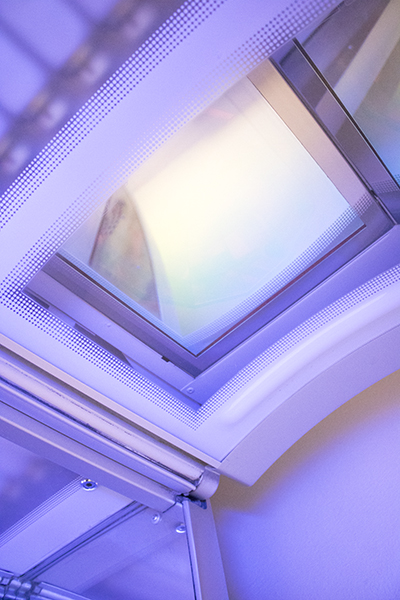
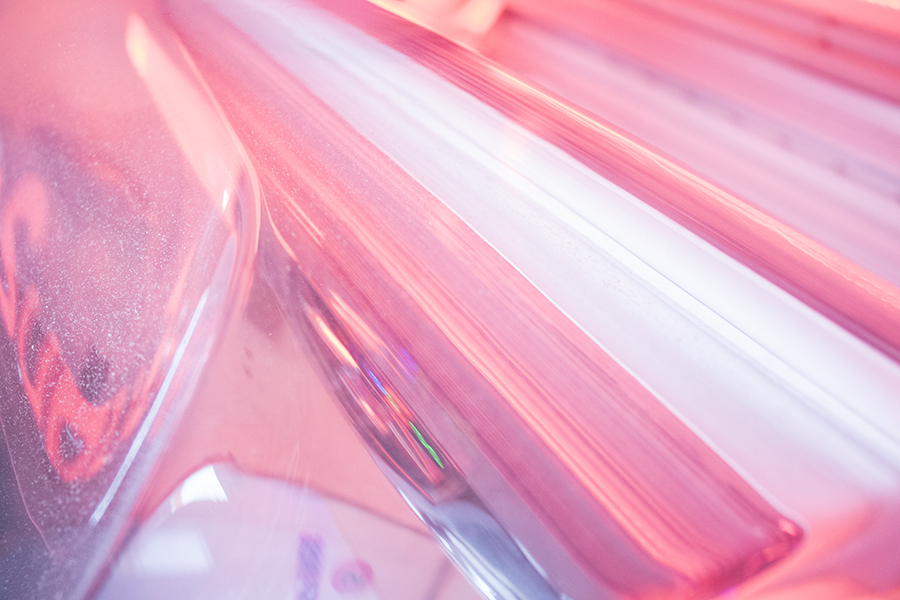
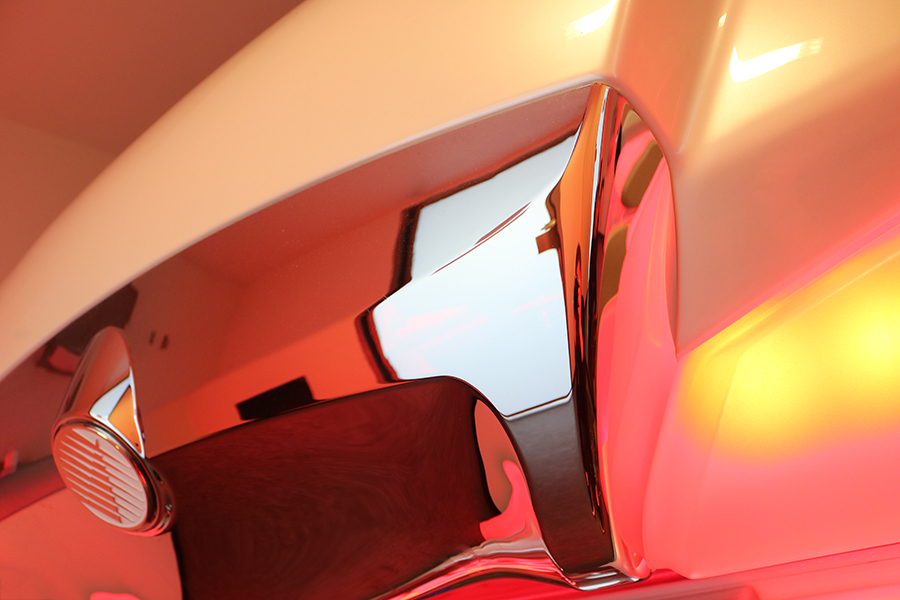
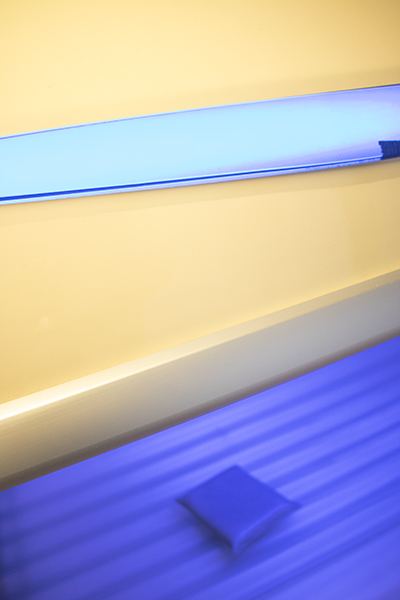
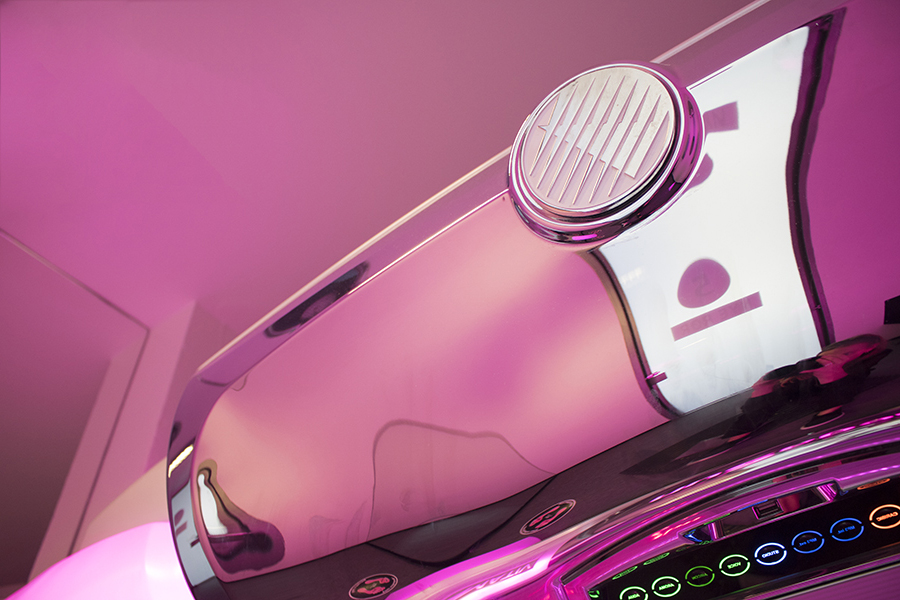
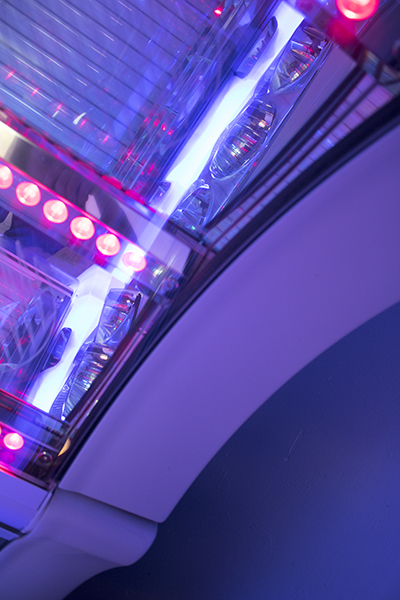
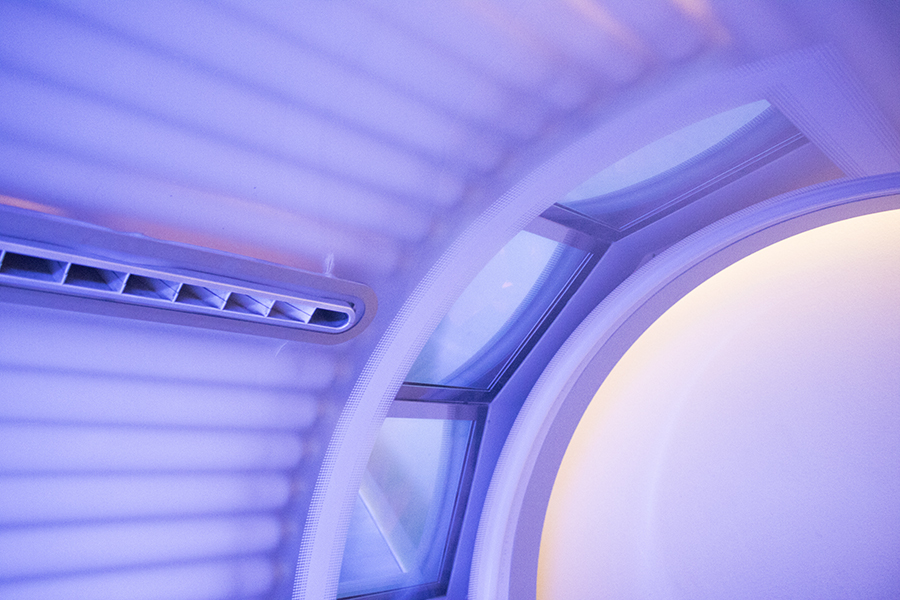
Sleek, shiny, aggressive next generation machines named and designed as space vessels, providing high pressure 650W lamps, intense facial tanning zones, luxurious Vitamin D treatment, innovative low pressure tubes, advanced customizable LED color systems, 4D surround sound and powerful Ruby–Collagen–Booster for increased hydration, revitalization, relaxation and detoxification of the skin for your tanning pleasure.
The tanning bed is a virtual reality space shuttle that instantly teleports its rider directly (in–)to the sun. It is an incubator, in the religious sense: a sacred rest area for experiencing divine dreams and cures. Being encapsuled in one of these devices is like donning a clumsy and immobile exoskeleton, a machine framework that augments some aspect of the human. Entering the tanning salon there are no smiling shop assistents to greet you; just gaping machines ready to absorb. These solitary salons are participants in the narrative of a service industry overtaken by machines, as depicted in so many dystopic science fictions. As such, the tanning bed is a product made for cyborgs, hybrids of machine and organism that transgress the natural–slash–artificial distinction between self–developed and externally designed.
The rhetorics, environments and aesthetics of tanning beds makes it clear that these are products of the future, or at least our contemporary fantasies and fears of what the future might be. As technological inventions, these machines are not just a consequence of human vanity, but of our eternal struggle to domesticate nature: The postmodern myth of Iccarus. The end of the world — by which we mean our world, the anthropocene epoch — is no longer a distant dystopic dread, but a plausible future scenario. If planet Earth becomes uninhabitable by humans, our longing to master nature, to artificially recreate our eco–system as we know it, is not an imagined but an actual need. The collapse of the ecosystem is caused by our hubris, our lack of moderation in our technological advances, our need to play gods. Paradoxically, the artificial reconstruction of nature seems to be where we might find our salvation. Under these circumstances, who can blame us for continously flying too close to the sun?